
Cradles, Trailers & Jackstands
A boat on shore needs support that handles the boat's weight without stressing the hull unduly. What this means in practice is that the cradle must be sized to place support at the hull's strong points, at or approximately at the bulkheads just in front of and just aft of the keel, and on a boat like the 27 Marks I to IV, it must compensate for the disproportionate weight placed on the bow by the keel shape. Saving a few hundred dollars on a cradle that doesn't satisfy these requirements can permanently damage a valuable boat. At the same time, the support must allow access to the hull for cleaning and anti-fouling painting. Above all these requirements, the support must ensure the safety of people working on the boat or in its vicinity; see more on this below.
The most common cradle in Ontario is made by Marine Cradle Shop in a 5-pad (principal example below) or 7-pad configuration. Dimensions of their C&C 27 cradle are given below. Since the Mk III and IV differ from the Mk I and II mainly in the length of the stern section, the Marine Cradle Shop cradle is identical for Marks I to IV. The same company makes the Cradle Ride trailers shown below.
Sailboats, trailers and your insurance company – Recently insurance companies have broadened the restrictions on trailering to all vessels. If you used to be exempt from the limitation on your radius of travel, you aren't now. Going more than 300 miles from home (yes, miles, in a country that's officially metric) will cost you extra.
1-12 | 13-15
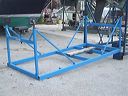
Forward quarter view
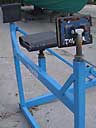
Front pads
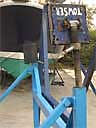
Pads
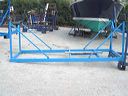
Side view
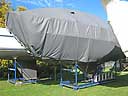
7-pad cradle
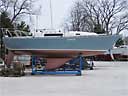
Hull 950 on its cradle
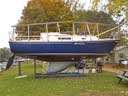
Hull 42 on its cradle
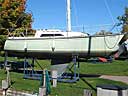
Mk V on its cradle
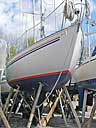
Layup safety
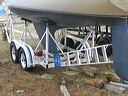
Cradle Ride trailer 1
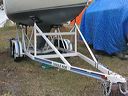
Cradle Ride trailer 2
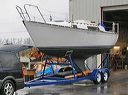
Custom-built trailer
Cradle Safety
Safety with respect to a cradle is largely common sense:
- Use a cradle that is sized appropriately for the boat, with pads and keel support in the right areas. Boats are built to be supported evenly by water and a properly sized cradle will make a good approximation of this support. Saving a few hundred dollars on a bargain 'near-fit' cradle can permanently damage a boat worth many thousands.
- Make sure the cradle is level when the boat goes into it, with all four corners and the keel crosspiece resting equally on the ground; block uneven corners with wood (not brick or concrete, which may break up). If the cradle is going on soft soil, 1' x 1' pieces of plywood, 1/2" or thicker, under the corners and keel will help reduce subsidence over the winter.
- Ensure that the boat is placed appropriately within the cradle, level and with the pads bearing on the correct parts of the boat (on or near a bulkhead; for instance, the Mark I shown above has external strainers that dictate a certain position within the cradle but the pads are very close to bulkheads).
- When working around the boat, painting and so on, drop only one pad at a time; watch carefully for movement. Do not allow anyone on the boat for any reason when a pad is down. Do not leave the boat alone when a pad is down. Consider using a jackstand or a 4"x 4" timber securely lashed or clamped to the cradle as a temporary replacement for the dropped pad.
Jackstand Safety
Safety with respect to jackstands requires skirting some pitfalls that appear to be common enough that Seaworthy, a magazine devoted to boat insurance loss prevention, devoted an article to recommended practices. Jackstand support failure is often progressive; a tarp tied to a stand works loose and begins to flap; the flapping loosens the jackstand and ultimately it falls. Or a block of wood between the stand and the hull falls out because the stand has subsided into gravel or weak asphalt, so the stand then falls.
Also, people are occasionally injured or killed by toppling boats, usually because the person is so preoccupied with working on the boat that he (and it's normally someone working alone) has moved a jackstand without thinking. If you use jackstands, it's worth taking these recommendations to heart:
- Use pairs, port and starboard, for every 10 feet of a boat's length (6 recommended for the 27) plus a bow support.
- Place the stands so the adjusting screw is as perpendicular to the hull as possible; the base should be positioned as far outboard as possible.
- All stands should be tightly chained together in pairs from port to starboard. Rope is not suitable as it stretches.
- Never tie the tarp to the jackstands as strong winds can catch the cover and move the stand.
- Plywood should be placed under the jackstand, even on a hard asphalt or brick boatyard. If the stand sinks, even a fraction of an inch, it can begin loosening progressively until it fails.
- Never add blocking between the pad and the boat as it can slip out. Never block beneath the jack stand in an effort to raise the stand as it can move and fail.
- Check the blocking periodically. Check to see that the pads are not depressing the hull.
- Exercise extreme caution when moving jackstands for hull maintenance. Two people working together have far more control than one person working alone. As when using temporary supports when moving cradle pads, placing an additional jackstand before you move a near neighbour is an intelligent precaution.
Cradle Dimensions
C&C 27 Marks I to IV are very similar in the mid-section, so one size fits all.
- Base: 2" x 3.75" steel section, 60" wide x 132" long; 2 crosspieces 26.5" and 61" from stern (measured to centreline of crosspiece).
- Bow posts: 41" above top of frame.
- Centre post: 35" above top of frame.
- Stern posts: 41.5" above top of frame.
- Adjusting jacks: 12" x 1.25" galvanized threaded rod.