|
C&C 27 Home
Overview
Evolution
Sea Change – MkV
Guide to Marks
Black Arts
The Fleet
27 Tales
History of C&C
Info & Events
Links & Contacts
Site Matters
Join Us!
Forum |
C&C 27 Association – Tools & Spare Parts
The following is published as a back-handed salute to a fellow (who shall remain
nameless, but he knows who he is) who interrupted his summer cruise to rent a car
and drive the 400-mile round trip from Kingston to Toronto and back because he
had neither a spare impeller nor tools to install it. If
you do find yourself in a situation like this, don't despair if the first inquiries
are negative – ask farther afield; it's impossible to believe that a sailing town
like Kingston couldn't provide an A4 impeller.
| Tool |
Type |
Use |
| Allen keys |
Standard plus metric if required |
|
| Bolt cutters |
18" (approx.) long |
Rigging failure (an offshore racing requirement) |
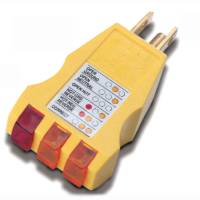
| Circuit analyzer |
basic circuit or additional GFI test |
Shore circuit safety tester (see below). |
| Drill bits |
1/16" to 3/8" set |
It's fairly easy to borrow a drill, less so to borrow sharp
drill bits – keep them greased and in a sealed box that keeps
them from rattling together, which dulls them. |
| Feeler gauges |
|
Engine, shaft coupling |
| File |
8"-10" fine-toothed flat |
|
| Hacksaw & spare blade |
|
A damage control must – see discussion below. |
| Magnet |
Strong |
Fishing for favourite tools that have
gone swimming. |
| Nut-driver |
5/16" |
The size for a hose clamp – eases an otherwise frustrating task. |
| Pliers (adjustable) |
2" |
Gripping larger objects (preferably
not nuts and bolts – that's why you have wrenches). |
| Pliers (needle-nose) |
|
Gripping smaller objects |
| Multi-meter |
Digital |
Electrical testing |
| Receptacle tester |
|
Tests receptacles for safe wiring – see note below. |
| Scissors |
Strong |
Toolbox scissors help you avoid "you're not
cutting that with my good scissors" spousal conflicts. |
| Screwdrivers |
Phillips – large
Phillips #1
Phillips #2
Robertson #1
Robertson #2
Standard flat, large
Standard flat, small
|
Everything from opening paint to mixing
drinks – can be used in a pinch to drive screws.
You need Robertson screwdrivers when working on C&C cabinetry. In the US,
you can order Robertson drive bits from Lee
Valley or buy "square drive" screwdrivers from Home Depot. |
| |
Picquic Sixpac or Mariner |
The exception to a general condemnation of multi-tools
of any type – this is a very handy multi-bit
screwdriver that's easy to use, and whose bits are hard to lose. |
|
Jeweller's flat and Phillips |
Electronics, sunglasses |
| Wire strippers, crimpers |
|
Electrical repair |
| Wrenches (Crescent® adjustable) |
10" and/or
12" |
Proper tools for handling nuts & bolts |
| Socket & wrench set |
Standard plus metric if required for your engine |
Proper tools for handling nuts & bolts |
| Ratchet wrenches (optional) |
Standard plus metric if required |
Like a box wrench but they ratchet like a socket driver – wonderful in tight spaces. |
| Vise Grips® |
10" |
A last resort – should be hidden from vandals who would
round off every nut on the boat, given a chance. |
| Utility/matte knife |
Retractable blade preferred |
You wouldn't dare use that cute "sailor's
knife" you got for Christmas, would you? |
Recommended spare parts
The following constitute a reasonable selection of spares for running
repairs.
- Bostik Blade-Cote (ex-Dri-Cote) is a Teflon-like lubricant for cutting tools
that is apparently virtually indistinguishable
from McLube, but about 1/4 the price. Use
it for luff grooves, sail slides, etc.
- bolt, 3/8" x 3 1/2" for
tiller-head
- bulbs for nav lights and interior lights
- copper washers to seal bleed valves on a diesel's fuel filters and fuel
pump as they should be replaced every time they are unseated
- crimp connectors, butt and terminal type, 12 & 14 gauge wire
- drive belts for alternator, fresh water cooling pump
- duct tape
- electrical tape
- fuel filters, primary & secondary
- fuses appropriate for engine panel (especially the starter solenoid fuse, if fitted)
- fuses appropriate for DC panel (if used)
- gasket compound
- gaskets for water pump and carburetor
- heat-shrink tubing
- hose clamps (selection)
- ignition switch for Atomic 4 instrument panel (prone to failure as they age)
- impeller(s) for engine water pump(s)
- manuals/owner's guide for the engine,
electronics, head and anything else you're carting around
- motor oil
- miscellaneous fasteners
- miscellaneous line
- miscellaneous wire (electrical and seizing)
- needle, sailmaker's palm and whipping twine
- penetrating oil
- rigging pins & rings
- sail tape
- shackles
- sealant
- spark plugs, points, condenser for Atomic 4
- starter switch for Atomic 4 instrument panel (prone to failure as they age)
- Teflon-based marine gel lubricant
- WD-40 or in the US only, 3M Spray Penetrant
(Universal sailor's remedy: if it's supposed to move and it doesn't,
WD-40 it; if it moves and it shouldn't, duct-tape it; finally, if it
works, leave it alone.)
- wire ties (the nylon ones that lock into their other end, essentially
unremovably) are tough, quick and easy to apply in a variety of
situations, but remember they break down after a few months of sunlight.
...And two tool boxes – one to keep your tools in, one to keep
your spares in. Plastic tool boxes (or Tupperware-style sealable tubs) are inexpensive
and don't rust or scratch surfaces. If things are rattling around loose, they'll
get damp, dirty or damaged. Ziploc freezer bags are ideal for things like
filters or electrical parts that you particularly want to keep clean
and dry.
Damage control
A limited selection suitable for coastal/Great Lakes waters.
- wooden plugs for each seacock plus a mallet and seizing wire to
secure plugs once they are in;
- epoxy-impregnated tape (from plumbing supply houses – will patch
a leaking pipe or hose even when wet).
It's probably just as important to think seriously about dealing with
emergencies as it is to have emergency gear. For instance, the cockpit
drain hoses on a 27 are internally wire-wound and very tough, so they
won't split easily, but if they did split and you couldn't close the
seacock, you'd have to cut the hose away before you could put a plug in
your seacock from inside. Remembering that you not only have to be able
to reach the affected hose, you have to be able to apply sufficient
force long enough to cut through. How would you do that?
Visualizing a problem and a solution is said to lead to a propensity
to act when action is required, which helps avoid situations like this:
a C&C 30 sank in Lake Ontario during the late seventies and the
people on board nearly died of hypothermia. The owner, an experienced
sailor, acknowledged that he panicked and never attempted to locate the
source of the leak in the half-hour it took for the boat to
sink.
Electrical testing
Most of us trust that our environment is safe, so we blithely tie up
at a new club or marina and plug ourselves in, believing that the place
is correctly wired. Usually it is, which is good because while a shock from
110V AC is unpleasant in normal circumstances, a 110V AC shock when you
are wet or just standing in a puddle is often fatal.*
Circuit analyzer
There is a really simple tool that can tell you if an outlet is safely
wired, so simple even a child can use it, with the rather daunting name
of circuit analyser. You put it in the receptacle you want to test and if
the right combination of lights goes on, the receptacle is correctly wired,
hence safe to use. A picture on the tool shows all the combinations with
their meanings, so you don't have to remember anything or read instructions.
If you're plugging into a twist-lock 30A connector, you can test the
circuit by plugging into a receptacle on your own boat.
Cost is under $10 in any hardware store, slightly more if you buy the
type that tests the effectiveness of a Ground Fault Interrupter receptacle.
* Ocean Navigator magazine warns that, whether a club or marina
has good electrics or not, you should never swim in it, due to the risk of
shock. The warning was prompted by the drowning and near-drowning of two
teenagers in 2011. Both boys were swimming in a marina and obviously there
was stray current in the water that paralyzed one; the other was injured
but managed to get far enough away to save himself. Counter-intuitively
(at least to most of us) the danger is greatest in fresh water. Salt water
is a uniformly good electrical path, so stray currents just go to ground.
Fresh water is a lousy conductor, so electricity finds a better path through
people. Zap, you're fried, paralyzed. Moreover, the person who jumps in to
save you will be fried too. Don't jump in; throw a line or grab a dinghy.
The expert advice is, don't concern yourself with how good a marina or
club is at managing its electrical service. Even if it may normally be a
safe environment, all it takes is a new or visiting boat with faulty wiring
and zap, you're in "hot" water. Don't swim anywhere (in marinas or clubs,
or near dock walls) where boats are or may be plugged into shore power.
There are too many variables to define what the danger zone is; go swim
somewhere else.
How good should your tools be?
No one likes cheap tools – they damage your hands and the part
you are working on, or they're just a pain to use, like adjustable
wrenches that won't hold their setting. Multi-tools belong in your kitchen
drawer (except the Picquic; see above in Screwdrivers). All-in-one too
kits, usually sold in bulky and unwieldy 'convenient' plastic containers
that lock each tool in place, generally contain tools that sailors
don't need or don't contain the ones they want; you are probably
better off picking and choosing your own selection. How good should they be?
You don't need the best, just good enough, which is the mid-price range.
Besides, experienced marine mechanics swear that top-quality tools like
Snap-On have an uncanny affection for water, the deeper the better, not
shared with such vigour by mid-price tools.
What's mid-price? One yacht-building company recommends Sears' brand
tools as a quality target – these are good mid-price tools that
often go on sale. Canadian Tire also sells comprehensive mid-price
socket sets for C$70-$100 that are more than adequate for weekend
mechanics. Their mid-price screwdrivers and wrenches are also good value.
Canadian Tire premium mechanics' tools are very high quality. Canadian
Tire often has tool sales, plus you get
Canadian
Tire money to misplace around the house.
When choosing tools for a serious maintenance job, or one that you will
do on a regular basis, look seriously into pro-quality tools if you value
your time. For instance, sanding bottom paint goes much more quickly if
you use a powerful random-orbit sander like a Bosch, paired with a
dust-extraction system. The sander will cost you at least $100, then
there are the costs of the dust-extraction hose and a small shop vacuum,
but the job will take half the time you'd need with some 'handyman'-quality
sander, and your eyes and lungs won't get filled with crud (which will
happen even with a good face-mask and goggles). Good tools also justify
their price by lasting much, much longer than the handyman stuff if you
look after them and don't let your friends leave them lying around in
the rain.
You may feel that you don't know how to use some of the tools listed
above, or that they are too expensive and "just for pros". Even if you
can't adjust an engine, the kind fellow who actually knows something and
is trying to help you can do a better job given the right tools. Also,
many other jobs, such as snugging up stanchion or toe-rail bolts, are
insanely difficult if not impossible in the confined spaces of a boat
without the right tools, which in this case would be a socket set.
|