This Forum is supported by C&C 27 owners like you whose membership in the C&C 27 Association makes possible this Forum and the accompanying site. Thank you, members, for your continuing commitment.
You are not logged in.
Dear "Guest"
I'm glad to hear you find it useful. I'm also glad to hear that your cheque is in the mail as the Treasurer has announced that she intends to take advantage of her position to high-tail it to Rio. Right now, hitchhiking looks like the only option. On the positive side, the President has announced that if she splits, paid-up members can strip her boat for parts. Bring a two-four.
Who are you, Guest?
David Weatherston
Towser, Toronto
C&C 27 Mk IV
If I recall correctly, I ran the transducer cables from their location in the under-seat locker, up to the outboard forward end of the locker. From there, they ran forward through the main bulkhead and into the lower head locker. From the lower head locker, they ran upward through the upper head locker to the underside of the deck, then back through the main bulkhead and aft above the lip of the deckhead liner to the galley lockers. From there, the path is obvious. At no point should the cables be visible.
David Weatherston
Towser, Toronto
C&C 27 Mk IV
This boat, by the sound of it, has nothing but problems - and you said you haven't even told us what they all are. You, the half-committed owner, are not interested in doing maintenance. Does this sound like a toxic mix? Does to me.
This is a serious project boat - a boat that has an array of visible far-reaching problems and probably has hidden problems that stem from them. It will be meat and drink to some guy who has time on his hands and sufficient experience to get at the problems, enjoy the process of solving and rectifying them, and doesn't mind that when he sells the thing, he'll make about $0.15 an hour for his effort.
You, by your own admission, are not that guy. It might be interesting to be your own contractor and oversee the repair of this little darling, but what you've described sounds like $30K minimum to me, Toronto prices. I imagine New York is a bit more. One way or another, you'll end up with a boat that will have cost you about two-and-a-half to three times what it would fetch on the open market.
You say you're in love with this boat? Well, now is the time to admit to yourself that you're in love with the idea of this boat: nice lines, good sailing manners, etc. but get it into your head that this is a production boat, not a one-off. Remember this magic number, 984. That's for the 984 C&C 27's that were built -- 984 of the little beasts -- a good number of which are bound to be in better shape than this little darling of yours, many of which are for sale and some of which are for sale at can't-lose prices.
Go find a 27 that won't break your heart.
David Weatherston
Towser, Toronto
C&C 27 Mk IV
Try EB Spars in Hudson, Quebec. If he can get a spar down to Derek Hatfield at Ushuaia, or wherever he limped to, he can probably get one to you. http://www.ebspars.com.
You don't say why the mast came down, but if I were you I'd replace the shrouds without a suggestion of an argument unless you can come up with positive evidence that they're still good. False economy to do otherwise.
David Weatherston
Towser, Toronto
C&C 27 Mk IV
Do they want the length of the boom or of the foot of the mainsail? That dimension is available in Evolution.
David Weatherston
Towser, Toronto
C&C 27 Mk IV
The bulkhead is marine ply with a very thin teak veneer.
There should be washers between the wood and the nuts; backing plates don't appear to have been needed. On my boat, they are simply the standard size for that diameter of bolt. It sounds as though your bolts have been a bit over-tightened. They should be tight, but not so tight that the wood is distorted.
You can have a look at your chainplate mounting-bolt holes to ensure that they're not elongated, but I wouldn't be too concerned. The major fear is that the deck has leaked where the chainplates pierce the deck and that entering water has caused rot. However, this will usually cause some staining or discoloration. If there's no discoloration or other sign of water entry, I'd leave it until you're ready to pull the chainplates and epoxy the surrounding cavity in the deck.
I would use the toe rail as anchor points for the halyards as it is much more securely fastened to the hull than stanchion bases. Incidentally, the inboard mounting holes of the bronze bases are notoriously points for water entry into the core - seal them with epoxy.
As a general note - don't try to do all this stuff in one day, week or even year - the boat has gotten this far without these fixes and while it's nice to get lots done while you're on a roll, it's important to get some sailing time in too, so you can bond with your new boat. Some jobs that you feel you must do will go away as others come to the fore. Meanwhile it's important not to get so mired in projects that you can't sail and end up browned off at your boat.
David Weatherston
Towser, Toronto
C&C 27 Mk IV
See the new illustrations in Black Arts >> Genoa Tracks. That should clarify the use of the term.
David Weatherston
Towser, Toronto
C&C 27 Mk IV
You should drill-fill-drill the handrail mounting holes, then dry-fit the whole works. When you're satisfied with fit, etc., do it for real with chosen bedding gorp. For compatibility with your handrails, you want to hold the existing hole positions as closely as possible when doing the drill-fill-drill routine. You could enlarge the upper holes if you wanted, because it would make balsa extraction easier, but you'd want to do something to ensure that you could replicate the present hole position as closely as possible. You don't have to be perfect - remember that the final holes have to be slightly oversize so there's room for bedding gorp in the hole.
I'm the wrong person to ask about silicon. Silicon and I don't like each other. I use 3M 5400 and 4300. Regardless of what you use, seal the circumference of the hole with epoxy. I skipped this the first time I bedded my chainplates. Fortunately, one of them sprang an obvious leak. I repairing that, I found that the balsa was quite wet, so I epoxied the lot.
This of course raised the issue of how you prevent epoxy from running out the bottom of a cavity that's already open at the bottom. The best stuff I've found is the red plastic tape used for sealing vapour barriers. Everything else comes off. For smaller holes, you can stuff a piece of coffee cup foam in the hole.
Good surveyors have known about the uncertainty of moisture meters forever and a day (never let one get started on this subject if you have anything else to do that day). That's one of the reasons the hammer is still their favourite tool. Good core sounds different from bad core.
Outriggers, eh? Listen - we've got some neat plans for hydofoils you might want to incorporate, too. But you've got to work on them where it's safe - a barn or better yet a bunker in Utah, or the United Nations will put rays in your brain and steal all your ideas. Better not write to the Forum any more, or they'll get your coordinates; we'll be in touch when we're sure you're not being watched.
David Weatherston
Towser, Toronto
C&C 27 Mk IV
We've never had an issue of "abuse" yet, so I'm not sure how we'd define it, except to say that, like art, I know it when I see it. In addition,
1) all your questions are reasonable, to the point and, most importantly, not stupid (anyone who asks for suggestions on installing a schooner rig on a 27 or how to turn it into a trimaran will get short shrift).
2) we appreciate the support you provide by joining the Association, instead of merely using the Forum.
Now, to the point of your questions -
If by "right before" you mean sometime this year, your balsa is certainly alright. For years, people thought that balsa core wouldn't rot meaningfully even if water entered, because the core is oriented with the grain bridging the laminate from the outer to inner skin. We now know that voids and age-related deterioration of the bond between the laminating resin and the balsa allow water to migrate then dive down through the end-grain to initiate rot. All this takes time, so if the handrail area is only newly wet, you have little to worry about.
However, if water has entered, you have to get it out. If you had the boat surveyed before purchase, the surveyor should have run a moisture meter over the deck. If he didn't mention it in his report, ring him up and ask. If you didn't get a survey, try to lure someone with a moisture meter on board to check the deck for you. Failing that, take off the handrails and dig out some of the balsa through each hole. That might tell you something. If the wood is damp, I'd put duct tape over the outside holes and let the area dry for a week for a little dampness, 2 weeks for signficant dampness, then get that moisture meter back on board.
When the area is dry, treat the area with epoxy (see the description in Black Arts under Genoa Tracks).
We used 3M 5200 to re-bed our handrails in '99 and they were dry last fall when the deck was checked; some people don't like 5200 because it's an adhesive as well as a bedding compound, but I think this is an appropriate use for it. Many people really like SikaFlex products; they are said to be as effective as 3M's and less expensive.
We dry-fit (no 5200) the handrails then taped the deck closely around the mounting areas. We then removed and re-mounted the rails for real, screwing them snugly but not aggressively (don't want to squeeze all the 5200 out). Next day, we gave each screw a half-turn, slit away the 5200 that had squeezed out onto the tape and we were finished.
David Weatherston
Towser, Toronto
C&C 27 Mk IV
>all of the required information that the factory manual provides.
I hope it gives you more info than my 2YM15 manual. When I found that I had no manual with the new engine, I had to badger Yanmar for about 6 months. Finallly a kindly service guy in Florida finally mailed me a .pdf. I wonder why I bothered. There are about 4 pages of useful information and 20 of safety warnings of the hare-brained "do not disassemble your engine while it is running" variety.
David Weatherston
Towser, Toronto
C&C 27 Mk IV
Here are two pics of a <a href="http://www.cc27association.com/photos/spreaders/spreaderbase.jpg"target="_blank">spreader base</a> and the <a href="http://www.cc27association.com/photos/spreaders/spreaderinbd.jpg"target="_blank">inboard end</a> of a spreader (complete with rad hose). Some people put cotter pins through the holes but I prefer machine screws with nylock nuts.
David Weatherston
Towser, Toronto
C&C 27 Mk IV
>It seems simple enough with a crane and unsafe without one, regardless of how much help is available. Is that correct?
That's more or less correct. The word 'unsafe', however, suggests that there is merely a possibility of either hurting someone or damaging something; 'dangerous' or perhaps 'criminally negligent' are closer the mark.
I'm sure you could devise some arrangement of sheer-legs and a spiderweb of lines that would avoid the use of a crane, but for the first time, a crane or bridge might be the more sensible option.
David Weatherston
Towser, Toronto
C&C 27 Mk IV
It's not difficult, and it's probably easier to do than describe - but you have to remember that it's a deck-stepped mast, so attach the lifting gear before you undo all the shrouds (you'd be surprised - perhaps appalled - at how many people have trouble with this concept). Two people can do it easily - I once stepped and unstepped it myself before I put roller furling on. The weight is carriable by two men, though three would be happier if there's any distance involved.
1. Strip the spar down to essentials - boom off, lines off the deck and secured on the mast and disconnect any electrics.
2. Secure a strop of line or webbing around the mast and attach it to lifting gear (mast crane, tackle attached to the railing of a bridge that's at least two feet above the spreaders, passing helicopter, etc.). Hoist this to a position under the lower shroud attachment points, with some upward tension.
3. Undo everything.
4. Raise the spar enough to clear the mast-step.
5. Walk the foot onto shore while slowly lowering and pivoting the whole business so it lands on prepared sawhorses.
6. Pull it all apart if you're storing it or simply fix the spreaders in your case and reverse the procedure.
There's a wealth of info on "tuning" and "rake" (search these words), so I won't repeat it.
David Weatherston
Towser, Toronto
C&C 27 Mk IV
Are you sure that your afternoon measurement is not just the surface charge that's present on any recharged battery? One tract I read said that the surface charge can last up to 12 hr, but went on to say that you can dissipate it and get a true reading (in a car) by leaving the headlights on for 5 or 10 minutes. Before you do anything dramatic, you might try comparing your morning reading with a no-surface-charge reading.
Also, one of the club's chief mechanics recently told me that published numbers for battery charge are all taken in ideal circumstances - in use and with a year or so on them, batteries will always deliver less than ideal voltages.
David Weatherston
Towser, Toronto
C&C 27 Mk IV
Search message for "Zinc anode" or "galvanic". I wrote a long piece about a conversation I had with a guy who knows a fair bit about the subject. Black iron and manganese bronze are fairly close, but most iron fittings are galvanized with zinc, which is a long way down the list and is thus sacrificial.
I know you're in cold water, which slows the reaction, but if I joined the two metals, I'd fret (and I don't like fretting). If I were you, I'd ask around and find out what the workboats do - that's probably the best option (but still inspect every year). The other thing you might do is ask Ralph Ainslie at DYC - he probably knows what the fishing and work fleet does.
David Weatherston
Towser, Toronto
C&C 27 Mk IV
We're getting a bit off topic here, but in a way, I have to sympathize with the WAFI guy, even if he was personally a jerk. The largest vessels regularly in Toronto harbour are the ferries, which are dinky by NY standards, but they're fairly unwieldy. Nevertheless, people regularly pull stunts like cross their intended track, then suddenly tack back in front of them or simply meander into their path.
Presumably this is a problem everywhere, as I recall a story from ages ago about Lowell North being fined by the Coast Guard for crossing about 50 ft in front of an oncoming freighter. Also, I read an article last year (Sailing World?) about San Francisco yacht clubs adopting fairly draconian measures to prevent racers from interfering with commercial traffic. It included some stories of unbelievable stupidity by grand prix level sailors.
David Weatherston
Towser, Toronto
C&C 27 Mk IV
Use the search function above and search the subject "rig tuning" for a number of ideas. There is one long and detailed post from Chicago that I think you'll find very useful.
BTW, a discreet word in your ear as you continue to discover sailing - "blow boat" is a term of derision adopted by men with small willies to mask their inability to understand a sport that relies less on hydrocarbons and more on intelligence. Its use, even in jest, will not make you friends.
David Weatherston
Towser, Toronto
C&C 27 Mk IV
[The Chicago sailor's post mentioned above has now been shamelessly ripped off and turned - with thanks to its semi-anonymous author - into a Black Arts article. Suggestions for additions are welcome. - Admin]
> I suppose I'll need to drill into the deck and add some.
Don't do that.
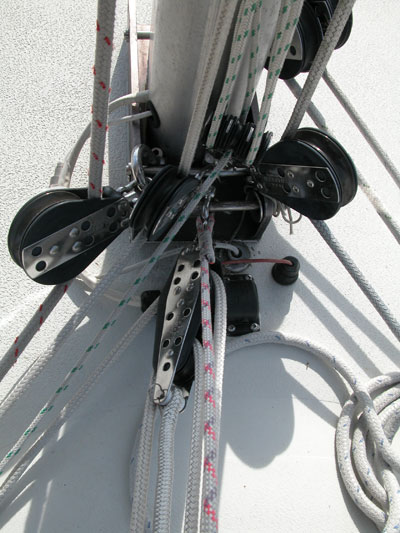
Ralph, I think, mentioned that blocks are normally secured to the alloy channel in which the mast base rests. You can see a photo here. This is a bit of a rat's nest, but I think you can see that the blocks are secured to lengths of rod that bridge the channel. There are additional holes at the forward end. Some people add a piece of alloy to the side of the channel and mount the blocks on standup springs, etc.
If you now go to Black Arts >> Genoa Tracks, some of the photos just show people's arrangements of line stoppers at the aft end of the coachroof and way off in the distance, the deck organizers that lead the lines aft.
David Weatherston
Towser, Toronto
C&C 27 Mk IV
One of the difficulties of talking about costs of maintenance and repairs, as I've noted on the page on buying a 27 in Black Arts, is that prices can vary widely - even outrageously - for the same job. I have every confidence that some shop would have extracted US$10K from Greg for a new diesel, but I have equal confidence that such a price is at the high end of the range, particularly for a drop-in replacement.
First, there are a couple of issues that need to be clarified when we talk about a job like this. One is money, or more accurately, currency. If I say my engine cost C$7,500, US readers have to understand that as approximately US$6,400. When Greg says US$10K, I see C$11,100, about 40% more than either Ralph Ainslie or I paid. Which rather reinforces my point. Then there is the issue of owner work. Ralph did almost 100% of the work on Hyperion, whereas I did a fair bit of work but more like 40%. Greg sounds like he'd be happy getting his hands dirty, too, but then his yard might limit his contribution. This is probably where most of the discrepancy lies.
All in all, though, I'll stand by the comment, and it's not meant to disparage Greg or the people with whom he was dealing - $10K (US or C) is high for a diesel and that assertion is based on replacing an A4 with a Yanmar last spring, so I am speaking from recent invoices, not estimates or conjecture.
David Weatherston
Towser, Toronto
C&C 27 Mk IV
Our Links & Contacts page lists two A4 manuals of different levels of comprehensiveness and price: Moyer's and the Atomic 4 Service Manual, which is oriented more to routine maintenance. I can recommend both at their respective levels for purely engine issues.
David Weatherston
Towser, Toronto
C&C 27 Mk IV
One of the perks of membership in the C&C27 Association is a pdf version of a 27 manual. Our version was scanned from a 1982 edition, but every page is individually dated, and many go back to the mid-seventies. Effectively, many of these pages are timeless, inasmuch as there can't be very many ways to wire an Atomic 4.
An e-mail will be going out sometime soon giving access to a downloadable version (30MB) for existing members. New members should have received a CD with their flags. Existing members who don't have high-speed can apply to the membership e-mail page for a mailed copy.
David Weatherston
Towser, Toronto
C&C 27 Mk IV
Just as a matter of interest, where are you that you paint on a tidal grid? The only place I've seen one is near Wolfville, NS.
My sense that you should be alright, swept keel and all, if as soon as you can, you wedge under the forward edge of the bottom of the keel (as we all do here when our boats are in our cradles). I'd also run lines to at least two cleats and/or other strong points in the bow and stern. (I'm basing this on a story from an English friend, recounting an episode of a drying-out that went entertainingly - at least to onlookers - wrong.)
Towser gets 1.5 litres of VC-17, laid on cold, on a cold morning. Soft coatings don't seem to go as far. Can you buy an extra can with the understanding that it might be returned?
David Weatherston
Towser, Toronto
C&C 27 Mk IV
It's really easy to find old Martecs sized for Atomic 4's - it you're lucky, you might even find a Gori for gas _or_ even diesel. Satan will skate to work before you find a used Flex-o-fold - they're too new and there's nothing more effective to make people want to upgrade. Save your pennies (and your breath to cool your porridge) and bite the bullet. (Perhaps you could make your fortune inventing a new cliche to join the preceding and use that to buy a new prop.)
David Weatherston
Towser, Toronto
C&C 27 Mk IV
South Shore Yachts, see the Links page, phone - don't e-mail.
David Weatherston
Towser, Toronto
C&C 27 Mk IV
So keep smiling. Join and support the organization that just saved you a) at least a tank of gas and b) several hours in the car. Only your membership makes this website and the information it contains possible.
David Weatherston
Towser, Toronto
C&C 27 Mk IV