This Forum is supported by C&C 27 owners like you whose membership in the C&C 27 Association makes possible this Forum and the accompanying site. Thank you, members, for your continuing commitment.
You are not logged in.
Frank:
The fellow you need to talk to is Ralph Ainslie from Dartmouth (NS, not UK), who contributed information on the rebuild project he did after Hyperion lost her rudder in a hurricane. I think you and Ralph actually corresponded at one point on converting a Mark I to a Mark III-style rudder. Ralph has a friend who is a real marine engineer, as opposed to an opinionated yacht-club-bar knowitall like the rest of us. This fellow specifically helped Ralph on the balance issue. Hyperion is listed (with Ralph's e-mail) in The Fleet.
David Weatherston
Towser, Toronto
C&C 27 Mk IV
Frank:
I think this book will answer many of your questions on foil design. I cannot recall anything on ship rudders, but the recommendation in "Basic Ship Design" may be a function of practicality more than anything else (though I seem to recall that US Navy cruisers of the 40's had a rudder with a low-aspect-ratio ellipse).
CS Yachts in Canada used to build a 27 drawn by an English designer, Raymond Wall. The CS27 had an outboard rudder that would blow out when running dead downhill at hull speed. It was the weirdest thing - I've had this happen on boats before when heeled hard over while beating or under chute, when the rudder ventilates wildly and the rudder simply becomes useless, but this was with the boat upright. We'd be sailing fast and suddenly the rudder would be gone. We thought it was the owner, but we put a really experienced helm on the tiller and it was the same. He could feel the change before it took full effect, and would push the tiller back and forth with his fingertips while cackling wildly. Then we'd wipe out.
The last time this happened, the owner accused me of causing the broach. He said I'd set the spinnaker inside out. There's no dealing with a remark that foolish (and he an Air Canada senior captain - seriously!), so I apologized and none of us never sailed with him again.
David Weatherston
Towser, Toronto
C&C 27 Mk IV
If I don't wash my lines every couple of years, they turn green (mildew) and grey (ass't crud). So I pull all my halyards every couple of years. As they are wire-&-rope with shackles (I'd like all-rope, but don't want to be bothered with the necessary replacement of the wire-&-rope sheaves), they only go in one way, which is to say, from the top downward. This renders some of the techniques discussed here unhelpful.
What works is to swipe a darning needle from my mother-in-law (they're blunt, fat and they have large eyes (darning needles – let's leave mothers-in-law out of it)). This I use to stitch a couple of zigs and zags through the tail of a halyard with polytwine (blue-&-white polyethylene twine that's about $5/1,000 feet). I then cover the zigs and zags with a bit of tape for that belt-and-braces effect and pull the halyard out from shackle to tail, pulling the twine up into the mast and down to the deck. After the halyard is freed, I secure the ends of the polytwine at the base of the mast.
After the halyard is washed (tied in a coil with string, shackles padded with bits of cloth, maybe in a mesh lingerie bag), I do the zigs and zags and tape again, then pull the halyard back up into the mast. It probably sounds fussy, but it's simple, foolproof and quick, with resulting clean halyards. More to the point, others may find the polytwine idea a quick and inexpensive way of shifting halyards.
David Weatherston
Towser, Toronto
C&C 27 Mk IV
Horace:
Get a Harken catalogue. It's hard enough working through some of the intricacies of this nonsense without simultaneously dealing with the limitations of web pages.
My track is at the forward end of the cockpit, like yours. My boat is tiller-steered, though, so it's easier to build an optimal setup for the helmsperson. For a wheel-steered boat, I'd go for Harken's windward-sheeting car for the main. That greatly simplifies the task, whether you've got a full crew or you're short-handed.
Gord:
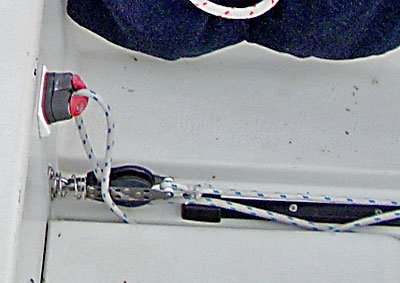
All I have, which is a piece of a picture meant to illustrate something else, is the arrangement at the coaming. This shows the Ratchamatic block, the cam-cleat and the blue flecked control line, which leads simply from the bottom of the Ratchamatic to a single block on the car. From the top of the cam-cleat, the control line leads to the top of the other cam-cleat. The line is continuous, so you can leave it cleated until the tack is complete. A tug on the line then pulls it out of the leeward cleat.
David Weatherston
Towser, Toronto
C&C 27 Mk IV
Towser's mainsheet system is: base: #152 triple sheave with ratchet & cam-cleat, upper: #004 double w. becket. This gives 5:1, at the price of a bit more string in the cockpit and slightly more labour at the leeward mark.
I have seen the setup you describe on neighbouring boats and I'm sure it works well, as a 5:1 purchase gives you finger-tip load levels.
The aspect of the mainsheet system I am most happy about is the cross-haul arrangement. This is a continuous line running from the car to a block at the coaming, up the cockpit side to a cam-cleat. This allows you to sit on the rail and adjust the car; as it's continuous, you can pull the leeward side out of the cleat without moving.
The point that sets it apart is the use of Ratchamatic blocks at the coaming. I feared a child getting him or her self on the wrong side of an unsecured car during a tack and getting walloped (in practice, adults are more likely to do this; children are too quick). With the Ratchamatics, any load locks the sheave, so the line drags slowly through the block and the car moves at a controlled pace down to the leeward side.
David Weatherston
Towser, Toronto
C&C 27 Mk IV
High rudder angles are an indication of other problems. Solve those, and
1) you don't need the mini-end-plates;
2) you won't be looking at so many transoms.
David Weatherston
Towser, Toronto
C&C 27 Mk IV
I thought about that kit, then decided to try getting the oil out via the port under the carb (which is where Mr. Moyer's fitting goes). Works fine. It takes a bit of care getting your fingers on the plug for the last few turns when putting it in or taking it out, but otherwise it's an acceptable solution. Cost: $0.
David Weatherston
Towser, Toronto
C&C 27 Mk IV
I asked a car dealer friend about his situation now that we have the aforementioned privacy laws.
He replied, "Funny thing is I don't even have to go to the Ministry as a Dealer, I can
just run the serial number through the Used Car Dealer Association web site
and it will give me the name, phone number and address of all the previous
owners, so the privacy law does not affect with cars and trucks."
Curious. I wonder if this is a case of over-zealousness on the part of the Customs officials (another golden opportunity to say 'no' to people). As I mentioned, one of the stated purposes of licensing and documentation has always been to prove ownership, but that function simply goes out the window if you can't verify it. Imagine buying a house without the opportunity to search title.
David Weatherston
Towser, Toronto
C&C 27 Mk IV
I'd just pump some more plumbing antifreeze through the system, making sure that there's some standing in the bowl. The baby oil is a nice idea, but you really don't want the toilet to freeze, do you?
David Weatherston
Towser, Toronto
C&C 27 Mk IV
Crikey! what have you got? Are you sure this sprays water, rather than flame? Sounds a bit different from my 20-lb. plastic toy. For all that, at 1,200 psi (Karcher's claim, not mine), it's more than strong enough to wash a deck. And yes, I'd avoid rubber, soft plastic and anything else you don't want to risk damaging (the club's Marine Services guys have one that takes VC-17 off the bottom, which sort of annoys me, because it's good from one year to the next).
Spray Nine sounds good, but I checked and it's not available in Canada.
David Weatherston
Towser, Toronto
C&C 27 Mk IV
>discoloration (sp?)
I would have said it's "discolouration", but the Oxford dictionary prefers "discoloration". Curious. Anyway...
I use a power washer when I can and this might be your best first step. It won't do anything chemically to your gelcoat and it will remove an amazing amount of crud. If there's anything left to remove after that, you can take some of the other advice that will doubtless be offered. Just don't point it at the joint between the toe rail and deck, because if will wash the bedding compound out.
While you're at it, clear everything you can out of the lockers and bilge, then hit those areas with the power washer. You'll be amazed at the difference. The only problem with these devices is that you will find yourself washing things that it would not otherwise occur to you to wash, like your porch ceiling. Exercise restraint.
David Weatherston
Towser, Toronto
C&C 27 Mk IV
Isn't it wild that instead of measuring your progress by reference to the medium you're sailing on, you're making decisions based on a datastream from something 22,500 miles away?
I'm not sure I understand why you're asking about the depth transducer. The photo shows a depth sounder transducer mounted under the port forward settee and I think the threads referenced on that page establish that it's a good location for these boats – especially given that there's almost no practical alternative. What's the issue?
Don't be too surprised to see C&C's far and wide – friend of mine found a C&C 34 at a marina in Zurich. South Shore (see Links) has all the original build and sales data. I don't know what their terms for a search are these days, but they certainly can tell you who the boat was sold to originally. In addition, your state licensing authority should know its history in Georgia; after all part of the rationale for paying that licence fee is that it provides some proof of title, so tell them you need an ownership history.
David Weatherston
Towser, Toronto
C&C 27 Mk IV
>And, you will almost certainly want a full face 3-M mask and painters coveralls. It is well worth the investment. It's a VERY messy job. Protect your eyes and lungs.
That's why I recommended using a rig like mine, with a dust extraction setup. It is astonishing how much it improves life if you're not fighting your way through a cloud of paint dust.
Personally, I'd be reluctant to use an 8" sander. They are so heavy that they're awkward to handle (we're not all as strong as you, Gord) and that leads to mistakes.
I used an epoxy barrier coat (see above) and you can get a very good finish with it. I wouldn't go any finer than 120 paper if using this, because epoxy bonds mechanically and it needs some "tooth" or roughness to get the best grip.
David Weatherston
Towser, Toronto
C&C 27 Mk IV
You can see the port side arrangement in a photo of Towser's genoa tracks in the Black Arts section on deck tracks – 4-sheave deck organizers forward followed by Spinlock dual stoppers for halyard and vang, with cam cleats for the outhaul and cunningham. This is almost identical to the setup on Yogi Bear, which you can see on the same page.
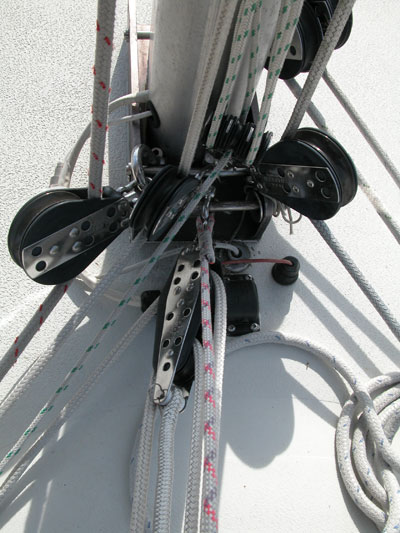
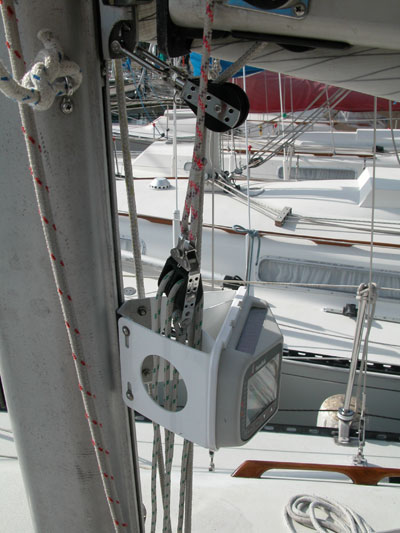
For what it's worth, here's a picture of the rat's nest at the foot of the mast and another of the inboard end of the boom. The fiddle block is the vang; everything else is outhaul and halyards except the small triple block, which is part of a tackle that handles the cunningham. The outhaul is internal to the boom (the block on the gooseneck simply prevents the outhaul from interfering with the compass bracket). In the boom photo, you can see a set of deck organizers similar to Towser's except for those being a single row of sheaves, rather than two-over-two as ours are.
David Weatherston
Towser, Toronto
C&C 27 Mk IV
If you want to clean your bottom to bare gelcoat but sandblasting is too pricey or unavailable, there's a product called "Peel Away" that is well regarded (West sells a variation). You brush it on, put a special absorbent sheet over it and leave it for an hour. You then pull the paper off and it brings the paint away with it. Because all the toxic stuff is now on the paper and can be stuffed in a bag, it's easier to comply with the environmental issues raised by paint removal. (I nearly did my boat this way, but the blasting option came up and I jumped for it.) That, however, is not the question you asked, and as this sounds like your first year with the boat, I'd leave this for another year.
If you've never painted your bottom before, it's not a big deal. The core issues are the same as painting your porch railings: remove dead or flaking paint, sand all surfaces to get good adhesion to the bare gelcoat or to existing paint, tape the waterline and roll the paint on in as even a layer as you can achieve. If you want a slick finish, roll-and-tip as described above.
A few caveats:
- When sanding, wear coveralls, goggles and a good-quality face-mask. Bottom paint is toxic (not kill-you toxic, but it's foul). Don't eat, drink or smoke until you've finished and washed up.
- Don't skimp on tools ($30 Black-&-Decker orbital sanders are a false economy). I have a Bosch random-orbit sander with a dust-collection hose connected to a shop vac. This rig probably cost $200, but the first time I used it was a revelation – not only does it do the job in half the time, it's so clean I barely have to wash my hands when finished, so I can sand in coveralls and a paper 3M mask.
- Find out what's on the bottom now if you're painting over something else. Some bottom paints will not adhere to other bottom paint, which is one reason I stripped my boat. If you can't get this information or an educated guess, buy a litre of your preferred paint and do a test patch.
Can't think of anything else. If this is your first time doing this, go down to the yard a couple of weekends before you plan to do your boat, watch people and ask questions. Admittedly this is tricky: the people who are working hard probably have the best information, but one is reluctant to interrupt them, whereas the people who are standing around pretending to work and available to answer questions are close to useless. If you can negotiate this little conundrum, it probably will resolve any remaining issues.
David Weatherston
Towser, Toronto
C&C 27 Mk IV
There is an article on "Heads, holding tanks and other nasties" in Black Arts that covers the wide world of bad boat smells.
David Weatherston
Towser, Toronto
C&C 27 Mk IV
There is an extensive article on replacement of all window types in Black Arts.
David Weatherston
Towser, Toronto
C&C 27 Mk IV
It's not caulk, it's methacrylate glue, and fixing it is not merely a matter of re-caulking. Read the material on windows in Black Arts.
David Weatherston
Towser, Toronto
C&C 27 Mk IV
The OMC Saildrive is basically a detuned 2-stroke outboard motor with a rubber motor/hull skirt halfway up the drive leg, so it has all the strengths and weaknesses of an outboard. Apparently, they are much reviled in salt water but sort of okay in fresh water. This is, however, a 20-yr-old outboard, so the prognosis is not good either way. There is a drop-in replacement called the Saildrive 280 that uses Volvo and Honda components.
Google the term, "OMC Saildrive" and you'll find a lot of information on how to look after one and even an an article from Sail on how to cut it out of your boat. The San Juan 28 association site links to a member's article on repowering an OMC-equipped boat with a Volvo saildrive. This fellow says parts are difficult if not impossible to find.
David Weatherston
Towser, Toronto
C&C 27 Mk IV
Triton Sails, 905-891-8166, on Lakeshore Road near the turnoff for Port Credit YC. Traditional tarps plus a variety of newer fabrics, flat or shaped, with frame or make your own. They made the cover for my first boat and for Towser. Excellent quality.
David Weatherston
Towser, Toronto
C&C 27 Mk IV
Take the quotation from Steve Colgate with a grain of salt. On our boat, we ease the backstay and halyard tension before furling. This is just as well, as it's not a good idea to go away and leave your furled genoa with a lot of tension on the luff, and we'd probably forget otherwise.
Our furling line runs forward through Schaefer blocks that fit around the stanchions, which keep the deck clear. I recommend them. We have a ratchet block on the stern rail to turn the furling line back to a cam cleat on the cockpit coaming. The ratchet block is nice for easing the sail out and for taking a breather when furling. We try to keep some tension on the sheets when furling so the sail rolls evenly and smoothly. We also put a sail tie around the sail when leaving the boat – a real belt-&-braces precaution, but I once saw a sail flog itself to pieces in a matter of minutes when a storm came through.
Gord is quite right about the limitations of sailing with a partly rolled genoa - the shape absolutely stinks and the roll of sail on the headstay makes for a foul entry, but you can roll it in and out in a minute, which is nice when you're sailing shorthanded or racing short legs.
David Weatherston
Towser, Toronto
C&C 27 Mk IV
Passenger aircraft manufacturers offer winglets for their aircraft, particularly the long-range models (Bombardier's Regional Jet has them too, but as it's reputed to be a thirsty little pig, that may be an act of desperation on the part of the designers). According to Salon.com's Ask The Pilot columnist, however, there is no consensus among major airlines as to whether the fuel savings are worth the installed price – some fit them, some don't. That may change with escalating fuel costs, but the present situation suggests that the benefits, in aircraft anyway, aren't in the same fuel-saving league as, for instance, serving scotch from foul-tasting plastic bottles or making you breathe stale air for 8 hours.
There is a long discussion of foil vortices and end plates in Steve Killing & Doug Hunter's Yacht Design Explained, a book that strikes a nice balance between depth and comprehensibility. I won't attempt to precis any part of long discussion of keel design other than noting that the greatest relative benefit is obtained by a foil with a long chord and low aspect ratio – which is not a Mk V.
During the last America's Cup, there was an extended discussion in Sailing World of the art of placing winglets on keel bulbs that suggested that this is not quite as straightforward as might be imagined – a little out of place, and they're almost pure drag. Moreover, in waves when the boat is pitching, your end plates are going to be operating at small but significant angles of attack; since they're flat plates, they'll stall easily and that will generate masses of nasty turbulence.
Finally, if I were a measurer faced with a wingletted boat, I think I'd "improve" your number by about 10%, just to be on the safe side. That would probably clip most people's wings.
David Weatherston
Towser, Toronto
C&C 27 Mk IV
My seacocks were in the condition you describe, neglected and corroded. I took off the worst of the corrosion on the barrels with progressively finer grades of wet/dry sandpaper. I got the worst off the bodies with w/d sandpaper, then coated the barrels with lapping compound (which was quite fine) and rotated the barrels for a while.
I cannot support the recommendations for a lubricant. I suspect that vegetable oil would quickly wash out and people would talk if they saw you taking a big jar of Vaseline down to the boat. I put mine back together with plain black axle grease. Since then I have discovered gearcase grease, which is made for outboard lower units, is very resistant to washing out in the presence of water and, unlike a lot of specialty stuff, easy to find (anyone who stocks outboard motor stuff) and not expensive. I use it in the grease cups on my engine and on my rudder stock and next time I do the seacocks, I'll use it there.
I'm not exactly the poster boy for seacock maintenance. I did mine properly about four years ago and I work them back and forth once or twice a season. They seem fine but I'm starting to feel guilty about them.
David Weatherston
Towser, Toronto
C&C 27 Mk IV
I cannot imagine what good a solar panel is going to do once it's got a foot or more of snow on it.
Personally, I hate removing my batteries and lugging them home. However, once, just once, a fellow I knew actually did have a battery die, freeze and crack. He was extremely unhappy about the resulting mess and he had a hard time finding someone to take the cracked case off his hands. I don't like it, but I take my batteries home.
David Weatherston
Towser, Toronto
C&C 27 Mk IV
Your traveller question appears to be answered, at least in part, in "Deck Layout (MkV) The fast set-up?" Have a look at the ideas expressed there and see if that doesn't help.
David Weatherston
Towser, Toronto
C&C 27 Mk IV