C&C 27 Association Forum
This Forum is supported by C&C 27 owners like you whose membership in the C&C 27 Association makes possible this Forum and the accompanying site. Thank you, members, for your continuing commitment.
You are not logged in.
- Topics: Active | Unanswered
Announcement
If you have any problem, please do not hesitate to contact me
#126 Re: General discussion » C&C 27 compared to a C&C Corvette » 2013-02-08 06:30:04
Corvettes are nice boats. A friend has one and loves it. Mind you, it's a bit narrow, which means a lot of the room provided by the extra length over a 27 is lost to the narrower beam (compare the interior layouts) and it feels like a much older design than a 27. There can be issues with the board, particularly if it hasn't been carefully looked after.
The issue of the Corvette's relatively larger main/smaller headsail vs the 27's smaller main/ larger headsail is a question only you can answer, but in my view, the relative smallness of both boats' sails and the efficiency of contemporary roller furling plus full-batten mains renders this a relatively unimportant question, even for a single-hander. If I were in your shoes, it would come down to which type comes up first with a good state of repair, good inventory (remember, inventory is a big part of the value of a boat, and if you buy a "deal" with clapped-out sails and other gear, your deal isn't going to look so hot) and a price that's appropriate to the boat's and inventory's state of repair.
You'd probably be happy with either. The only deciding issue would be the local presence of a bunch of Corvettes or a bunch of 27's to race level against.
David Weatherston
Towser, Toronto
C&C 27 Mk IV
#127 Re: General discussion » Ice in Bilge » 2013-02-05 05:45:30
You can get a lot of water in the boat from condensation, particularly if we go through a number of freeze/thaw cycles. Don't worry about it. The sides of the bilge are not parallel, so the expansion of the ice won't do anything bad. RV antifreeze really isn't necessary. Whatever you do, don't put engine antifreeze in the bilge; it seems to create worse issues.
David Weatherston
Towser, Toronto
C&C 27 Mk IV
#128 Re: General discussion » Book to add to your sailing library: here's my suggestion, what's yours? » 2013-01-29 06:40:16
Moby-Dick. Many people are frightened of the book because it is long and complex. Some of that complexity is the nautical component, which most people find perplexing or just boring, but sailors will enjoy. Read it in the Norton Critical Edition, whose copious footnotes explain the complex allusions and the whaling methods that are lost on most of us.
If you enjoy Moby-Dick, try In the Heart of the Sea, by Nathaniel Philbrick, which recounts the story of the whaler Essex, sunk by an enraged whale, and the survival of a few of her crew by cannibalism. Sounds lurid, but it provides more illumination of the life of sailors and their home-ports.
David Weatherston
Towser, Toronto
C&C 27 Mk IV
#130 Re: General discussion » Toe rail dams water » 2013-01-20 12:46:10
A very dull day - last day of the Toronto Boat Show, the day that everyone describes as the "divorced dads looking for something to do with the kids on custody day", and worse, what one boat salesman described to me earlier in the week as "63 days to sailing season". I hope he uses a calculator to price boats, because by my reckoning, it's a good three months - 90-odd days. A long, grim haul of salt, slush and bottom-sanding and naught but wine and whisky to sustain us. Bear up, Alan.
David Weatherston
Towser, Toronto
C&C 27 Mk IV
#132 Re: General discussion » Draft specs all over the map » 2013-01-19 07:07:47
So, 500 lb per inch immersion means, leaving aside owner's and guests' junk, that 2.86 Standard North Americans (SNA @ 175 lb. ea. average) or 2.5 Standard North American Fatties (SNF @ 200 lb. ea. average) will immerse the vessel a further inch. However, since they'll all be sitting in a row in the cockpit like bumps on a log and there probably will be four of them, the poor 27 will be down 3-4 inches by the stern, up two in the bow. Not pretty and they'll all be wondering why they're not fast.
David Weatherston
Towser, Toronto
C&C 27 Mk IV
#133 Re: General discussion » Draft specs all over the map » 2013-01-18 00:39:06
What Chuck may be alluding to is the existence of this information on the site - in this case in Evolution (see above), hence surprise at the question.
Evolution gives the official numbers. As any sailor will know, though, official numbers for draught never survive the first loading of inventory: anchors, chain, pots & pans, alcohol, etc. Call it 4'9" to be on the safe side.
David Weatherston
Towser, Toronto
C&C 27 Mk IV
#134 Re: General discussion » Electrical panel » 2013-01-15 12:13:43
There was a long thread about replacement panels some years back and if I recall correctly, the tide was in Blue Seas' favour for quality and general suitability. Unfortunately, I can't find it. Perhaps someone else's memory is less thoroughly derailed.
David Weatherston
Towser, Toronto
C&C 27 Mk IV
#135 Re: General discussion » Electrical panel » 2013-01-11 04:11:06
#136 Re: General discussion » Toe rail dams water » 2013-01-06 07:02:56
There was a Mk II at our club with the base on the toe rail cut through to allow water to drain. It struck me as an over-reaction to a minor aesthetic problem, given the undoubted significant contribution made by that rail to the boat's strength.
There was a period in the 80's when _everyone_ was fitting cute little drains along the toerail to deal with this "problem". It seems to have stopped when people realized they were adding several hundred dollars in cost plus two more through-hulls below the waterline to solve a problem that can be solved with a 25-cent sponge.
David Weatherston
Towser, Toronto
C&C 27 Mk IV
#137 Re: General discussion » New page » 2013-01-04 03:35:16
You'll see a similar arrangement in St Malo, where the tidal range is something on the order of 7 meters, not far off the Fundy tides (they have a tidal power dam just up the estuary that generates power from both the ebbing and flowing tides). Unlike the Eastbourne arrangement you describe, though, when St Malo's gates close, they're closed until the tide has risen to some target height. As they say in the parking lots, 'no in-and-out privileges'.
David Weatherston
Towser, Toronto
C&C 27 Mk IV
#138 Re: General discussion » Life line covering » 2013-01-03 03:44:12
I wish I'd thought of the lashing trick before, but I think we have a good setup on Towser. The original lifelines were continuous from bow to stern, with a stopper on the aft side of the first stanchion forward of the cockpit. In theory, when you undid the pelican hook at the pushpit, the stopper would keep the forward lifelines taut while allowing the lifelines at the cockpit to drop down onto the deck, out of the way of anything you might be doing over the side.
Of course, the stopper didn't work very well, so when I replaced the lifelines three or four years ago, I terminated the aft end of the forward part of the lifeline with a gate eye on the aft side of the stanchion just forward of the cockpit. The other half of the joined gate eye runs to the pushpit, terminating in contemporary pelican hooks (these actually work, unlike the old Merriman pelican hooks they replaced). Since the stanchion has a brace on it, we can undo the pelican hooks and drop the lifelines right out of the way without losing tension on the lifeline forward of the cockpit.
On the question of knives – Most, if not all the boats I've raced on over the years have had a very sharp knife taped to the vang piston, mast or binnacle and I can recall at least one incident where that kept a serious problem from getting worse. On Towser, I made a brass bracket that accepts the belt loop of the leather sheath of a very sharp knife; it's mounted at the top of the companion. Its only use so far has been to cut a fouled anchor line on a club committee boat, but I am glad to have it there.
Alan, you don't mention how the other (non-turnbuckle) end of your lifelines terminate, but one way to make them instantly droppable would be to replace the turnbuckle with a threaded gate eye (fixed with permanent Lock-tite) and run the lashing between eye and pushpit. You could keep a knife in your sheet bags, or bulkhead-mount a knife as on Towser.
David Weatherston
Towser, Toronto
C&C 27 Mk IV
#139 Re: General discussion » New Rope » 2012-12-14 02:00:37
Towser is used for a mix of club racing and daysailing. As I said, we're all used to the lighter lines, so there are no handling issues. In fact, quite the contrary.
As to stoppers, I have to say that I'm not thrilled with our new Spinlock stoppers. They're better than the old Spinlocks, but that's not saying much. A friend removed all the Spinlocks from his C&C 99 and replaced them with Lewmar stoppers, which he is very happy with. Anyone else have any experience with different types?
David Weatherston
Towser, Toronto
C&C 27 Mk IV
#140 Re: General discussion » New Rope » 2012-12-10 04:09:26
Towser is a MkIV, so the sail sizes are slightly larger than yours, but the difference is not huge and some of this may help.
Towser is almost all 5/16" Spectra sheets, guys and halyards. The cunningham and outhaul are 3/8" dacron, and the mainsheet is 7/16" (but is due for replacement). I've never heard any complaints about holding the lines; it's what we're all used to and of course, contemporary sticky gloves help. Every line is a different colour for easy identification when the cockpit turns into a rats-nest; this is also a great asset when sailing with people who aren't familiar with the boat.
The primary advantage of thinner lines is that they run through the blocks much faster than thicker material. The disadvantage that people don't mention is that clutches don't grip as well (even the ones ostensibly for that size of line, and if you're going from 7/16", you need to switch), nor do the grippers on our self-tailer primaries. On balance, though, I'd say the lighter line is an unreserved positive.
As to price, I got most of our new line during winter specials - 30 and 50 per cent off if I recall correctly. For the sheets and guys, I just said the hell with it and paid retail, but think I was working more int the $1.60/ft range (you need to go back and put some decimal points in your prices).
Hope this helps.
David Weatherston
Towser, Toronto
C&C 27 Mk IV
#141 Re: General discussion » "Original Equipment" MK III offer! » 2012-12-07 03:38:45
Two-thirds may sound aggressive, but this really depends on the starting point. What's the going rate for similar craft in your area? Ditto for areas within reach - major metropolises aren't that far away and there are a lot of "committed" (= desperate) sellers out there. Just as a point of reference, a 27 that sounds like the mirror of the boat you are considering (Mk III, lightly used, never upgraded) sold quickly at my Toronto club for $15k asking (we don't know the final price).
As with the boat you are looking at, much of the inventory was tired to the point of uselessness. Thirty+ years doesn't matter much for anchors and rodes, but at that age, the fibres in the sails are beginning to break down to the point that they damage easily and aren't repairable; you could end up with a split mainsail in the middle of your much-anticipated cruise. By the same token, the foam in the cushions is probably turning to powder.
I suggest that you have the boat surveyed. Lightly used is often coupled with "lightly looked after" and as we all know, the smooth sheen of good gelcoat can hide a multitude of issues. You will need the survey for insurance purposes if you buy, and a good surveyor will be able to give you some indication if the price is reasonable, or a reasonable justification for offering less.
David Weatherston
Towser, Toronto
C&C 27 Mk IV
#142 Re: General discussion » Life line covering » 2012-12-01 01:56:10
Towser has slip-on shroud covers over the lifelines to protect the plastic-covered wire underneath from chafe by sheets and guys. This looks pretty good and might fill the bill for you.
However, I will add that the plastic-covered wire is new as of about three years ago. I read a story in some mag about how the stainless wire can corrode under the plastic and decided that after 25 years or so, the old wire had earned its rest.
David Weatherston
Towser, Toronto
C&C 27 Mk IV
#143 Re: General discussion » goose neck C&C 27 » 2012-11-30 05:30:49
This only shows the underside of the boom, but is the best I can do for you. The hole at the bottom of the gooseneck slide is used for a block that re-leads the outhaul line. The white/pink/mauve line is the cunningham and leads from the mast base up to the cunningham eye and back down to the tack pin. Note the small block of alloy fastened by a screw tapped into the mast, under the gooseneck slide. Along with a similar bit above the slide, this keeps the gooseneck fitting in a fixed position. I can't imagine why this would have been changed.
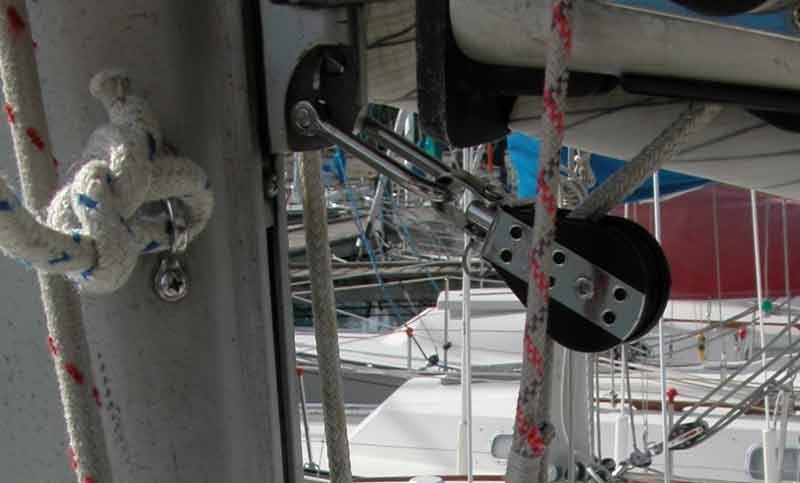
David Weatherston
Towser, Toronto
C&C 27 Mk IV
#144 Re: General discussion » goose neck C&C 27 » 2012-11-15 04:09:09
Unless you have a very early boat on which a sliding gooseneck was the equivalent of the cunningham and halyard as your luff-tensioning tool, the gooseneck should be fixed, usually with a machine screw in the track above and below the gooseneck slide, if I remember aright. Of course, if you are still using the roller-boom to reef, you might want to keep the sliding gooseneck and just add a downhaul tackle below the boom, but I think you would be happier fixing the gooseneck position and adding a cunningham. I'm sorry, but I cannot tell you at what height to fix the boom because my boat is put away.
Anyone else out there have access to a mast so they can measure the distance between the slug cutout and the top of the gooseneck fitting?
David Weatherston
Towser, Toronto
C&C 27 Mk IV
#145 Re: General discussion » goose neck C&C 27 » 2012-11-15 03:31:09
If you mean the single transverse hole in the bottom of the gooseneck fitting, it probably dates from the time when the mainsail luff was controlled by pulling the entire gooseneck fitting downward; there would have been a little Tuffnol block there. I mount a block there that slightly changes the lead angle of my outhaul line. I can't imagine any other use.
David Weatherston
Towser, Toronto
C&C 27 Mk IV
#146 Re: General discussion » Contact for George Cuthbertson » 2012-11-09 08:53:54
How important is the project to you? Do you have access to a boat? Making a truly accurate model (taking the lines off an extant boat) would be a lot of work (but doable - I'm sure someone in the Marine Museum in Halifax would be able to point you to a source of instruction). On the other hand, if all you want is a boat model that looks sufficiently like a Bluejacket to please the eye, half an hour with a camera would probably give you enough views to turn the trick.
I probably shouldn't repeat this, but an exchange student we had living here gave me a model kit for the Bluenose for Xmas. Now, to me and probably to you, this model looks nothing like Bluenose, but I painted it carefully in Bluenose colours and everyone thinks it looks lovely (I like it, but it only looks like Bluenose in the most general way). Your mileage may vary.
David Weatherston
Towser, Toronto
C&C 27 Mk IV
#147 Re: General discussion » Contact for George Cuthbertson » 2012-11-08 10:10:15
If George Cuthbertson had a Bluejacket 23, it is probably because he designed it (and I can't imagine any other reason for him to have drawings). If he designed it, the drawings are probably with the Marine Museum in Kingston, ON; you should enquire there as it is extremely unlikely that Mr Cuthbertson would have any material on that or any other boat after the major transfer of his papers to that institution.
The transfer, which is relatively recent in museum terms, was large and since like most museums, the Marine Museum is underfunded, cataloguing of Mr. Cuthbertson's papers may take some time. Do not expect a quick response to an enquiry.
David Weatherston
Towser, Toronto
C&C 27 Mk IV
#148 Re: General discussion » Mast Up - Mast Down for Winter? » 2012-11-01 02:52:21
There are a lot of people who know as much as or more about these boats. I do, however, have the misfortune of having run this site for a long time, so I do know where the answers are. In short, I'm an "aggregator" rather than an expert.
I don't see much point in meeting at Towser in the winter as she is tightly tarped and in spring, prep time on the Island is precious. We might possibly meet at TS&CC - I used to race Wayfarers there on Thursdays and still have friends there. I will let you know if I'm coming to any event.
Just to keep you going, though, a thought... Why not compile a list of questions, right now when they're still fresh in your mind, to which you want answers? Search the Forum for extant answers first, though. Ask the group all the questions that pertain to lay-up right now. Come March, ask the launch prep questions. And so on. You'll ask better questions and get better answers when the topics are top-of-mind for you and for your responders. (A printer once told me that if you want to see the best quality from any press, ask them to print a hockey book during the play-offs - the pressmen are interested, they're motivated and there won't be a dot out of place - it's kinda like that.)
David Weatherston
Towser, Toronto
C&C 27 Mk IV
#149 Re: General discussion » Looking for C&C 27 blueprints or technical diagrams » 2012-10-20 09:07:05
Doug's drawing was done in Adobe Illustrator, so you can turn layers on and off. This means that you can show the Mk I or Mk II alone, or both combined as seen. The Museum would probably have drawings of the 30. We don't.
Incidentally, there was a man from the Belleville or Trenton YC at the Shellbacks meeting in Toronto this past Wed., who said he had just bought moulds for halfmodels of all C&C's production boats. It was unclear what he intended to do with them beside donate them to the Marine Museum. Using the moulds struck me as a nice retirement business for someone (trade a finished half-model for x number of copies from that particular mould or something like that). Otherwise, what's the point?
David Weatherston
Towser, Toronto
C&C 27 Mk IV